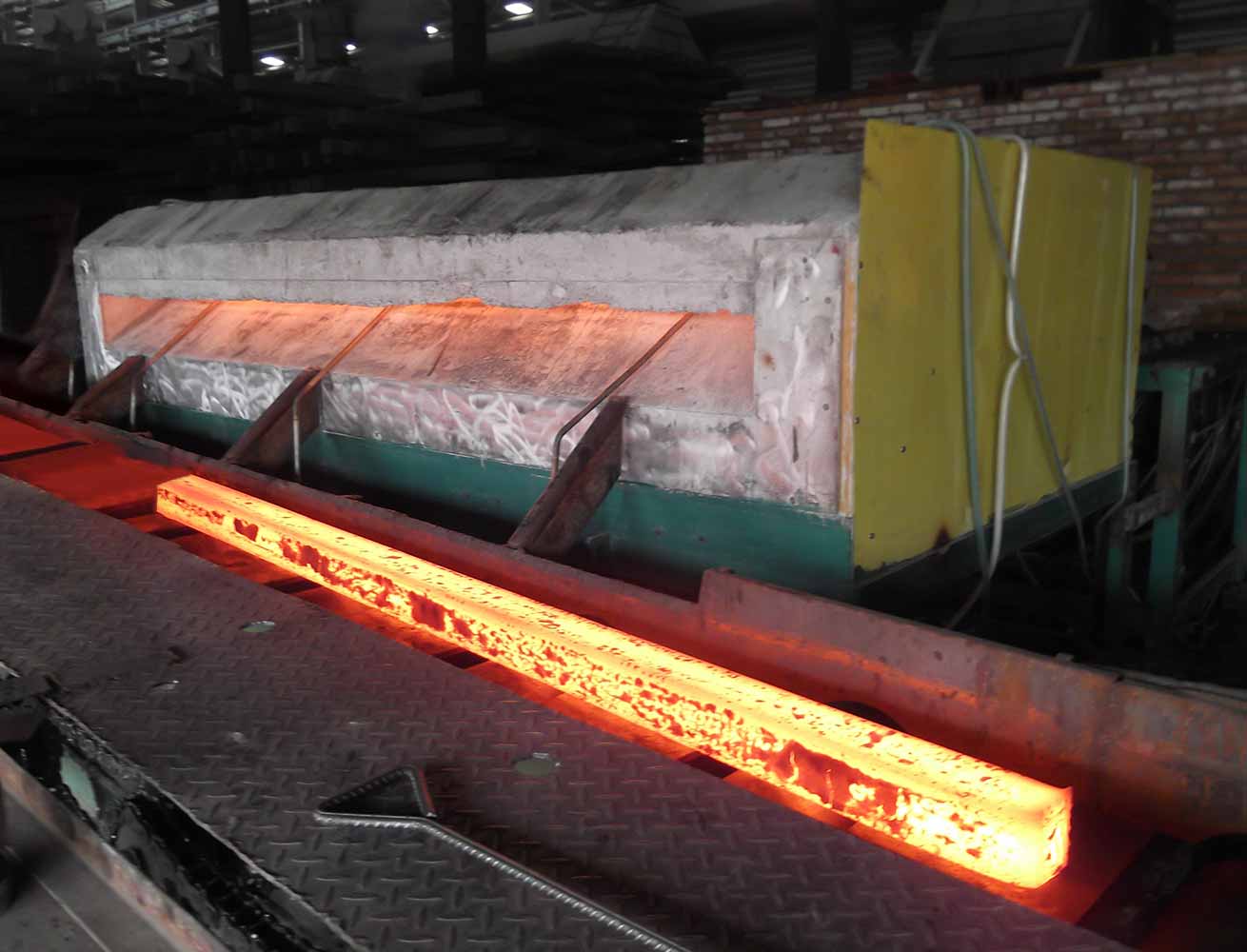
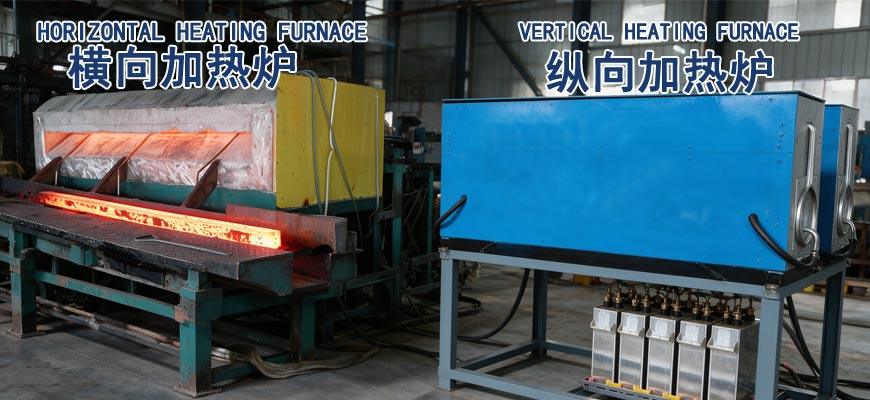
This product adopts a horizontal split structure design, the workpiece runs horizontally through the furnace chamber, with convenient loading and unloading operation. It is suitable for batch continuous heating of long bars and pipes, and is equipped with a mature medium frequency power supply control system, featuring uniform heating and low oxidation loss. It is mostly used in industrial processing scenarios such as pre-forging penetration heating, pipe heat treatment, and profile hot forming.
The complete set of horizontal medium frequency induction heating equipment includes components such as medium frequency power supply cabinet (KGPS/IGBT optional), compensation capacitor bank, horizontal induction furnace body, circulating water cooling system, horizontal conveying mechanism, infrared temperature control device, operation control cabinet, etc. It is suitable for integral or sectional heating of carbon steel, alloy steel, copper and aluminum profiles, various alloy round steels and steel pipes, featuring fast heating speed, wide adjustable temperature range and low workpiece burning loss, and is compatible with continuous heat treatment operation of assembly lines.
Non-standard equipment with corresponding power, furnace chamber length and conveying speed can be customized based on the workpiece diameter, length, heating temperature and hourly output.
The horizontal medium frequency induction heating furnace is based on the principle of electromagnetic induction heating, following the law of electromagnetic induction e=W*-dΦ/dt. The medium frequency power supply converts power-frequency alternating current into medium-frequency alternating current, which is fed into the horizontally wound induction coil to generate an alternating magnetic field; the magnetic field passes through the horizontally placed metal workpiece, and induced eddy current is generated inside the workpiece. Joule heat is generated by virtue of the metal's own resistance, so as to realize uniform penetration heating of the workpiece from the inside out, and complete heat treatment processes such as forging preheating, quenching and tempering, with fast heating response and good heat energy utilization.
It is widely used in forging penetration heating, round steel bar heat treatment, copper and aluminum pipe heating, standard part hot forging, shaft quenching and tempering, hardware profile hot forming, scrap metal preheating and other industries.
| Billet Diameter (mm) (Customized on Demand) |
Power (KW) (Customized on Demand) |
Medium Frequency (HZ) (Customized on Demand) |
Input Voltage (V) (Customized on Demand) |
Number of Transformer Phases |
|---|---|---|---|---|
| All Parameters Can Be Customized | ||||
| Square Steel 60×60 | 800 | 500~8000 | 380 | 3 Phase |
| Square Steel 60×60 | 1000 | 500~1000 | 380 / 660 | 3 Phase |
| Square Steel 70×70 | 1500 | 500~1000 | 380 / 660 | 3 Phase |
| Square Steel 80×80 | 2000 | 500~1000 | 380 / 660 | 6 Phase |
| Square Steel 100×100 | 3000 | 400~1500 (Dual Frequency) | 1000 | 6 Phase |
| Square Steel 120×120 | 5000 | 80~1500 (Dual Frequency) | 1000 | 12 Phase |
| Square Steel 130×130 | 5000 | 80~1500 (Dual Frequency) | 1000 | 12 Phase |
| Square Steel 130×130 | 8000 | 80~1500 (Dual Frequency) | 1000 | 24 Phase |
| Square Steel 150×150 | 8000 | 80~1500 (Dual Frequency) | 1000 | 24 Phase |
| Square Steel 150×150 | 10000 | 70~1500 (Dual Frequency) | 1000 | 24 Phase |
| Square Steel 200×200 | 10000 | 70~1500 (Dual Frequency) | 1000 | 24 Phase |
* The above data are typical parameter configurations. Specific configurations are customized according to heated workpieces and process requirements, all parameters can be adjusted, please consult our sales team.
Note 1: The heating rate data is measured when heating to 1100°C. If the heating temperature is higher than 1100°C, the heating rate will decrease proportionally. The number of pieces per hour (heating cycle) can be calculated based on the heating rate and unit weight of the workpiece.
Note 2: Power calculation and other parameters can be customized according to customer requirements.